


The Startup Friendly Cities Index 2026
Introduction
The geography of entrepreneurship is being rewritten.
In today’s economy, cities - not countries - are the real frontiers of innovation. They are the ecosystems where talent concentrates, capital circulates, and ideas take physical shape.
Cities need startups. They generate momentum, a culture of invention that renews the urban economy from within. Startups recycle local wealth, train the next generation of builders, and signal to the world that a city is open for possibilities. The vitality of a city’s startup ecosystem determines its global relevance as much as its infrastructure or GDP. A city without a living startup ecosystem risks becoming a museum of its past success. A city that gets it right becomes a magnet for innovation and talent.
The Startup Friendly City Index captures this new reality. It reveals which cities have nurtured fertile ground where founders can plant ideas and scale them. From Dubai’s speed to Zurich’s precision, from Singapore’s Fiscal intelligence to San Francisco’s venture capital ecosystem, the world’s most start-up-friendly cities are proving that entrepreneurship thrives where the system works.
As the geography of entrepreneurship continues to shift, one truth has become clear: the competitiveness of cities depends on how well they enable people to build.
The Startup Friendly Cities Index 2026
Introduction
The geography of entrepreneurship is being rewritten.
In today’s economy, cities - not countries - are the real frontiers of innovation. They are the ecosystems where talent concentrates, capital circulates, and ideas take physical shape.
Cities need startups. They generate momentum, a culture of invention that renews the urban economy from within. Startups recycle local wealth, train the next generation of builders, and signal to the world that a city is open for possibilities. The vitality of a city’s startup ecosystem determines its global relevance as much as its infrastructure or GDP. A city without a living startup ecosystem risks becoming a museum of its past success. A city that gets it right becomes a magnet for innovation and talent.
The Startup Friendly City Index captures this new reality. It reveals which cities have nurtured fertile ground where founders can plant ideas and scale them. From Dubai’s speed to Zurich’s precision, from Singapore’s Fiscal intelligence to San Francisco’s venture capital ecosystem, the world’s most start-up-friendly cities are proving that entrepreneurship thrives where the system works.
As the geography of entrepreneurship continues to shift, one truth has become clear: the competitiveness of cities depends on how well they enable people to build.
Introduction
The geography of entrepreneurship is being rewritten.
In today’s economy, cities - not countries - are the real frontiers of innovation. They are the ecosystems where talent concentrates, capital circulates, and ideas take physical shape.
Cities need startups. They generate momentum, a culture of invention that renews the urban economy from within. Startups recycle local wealth, train the next generation of builders, and signal to the world that a city is open for possibilities. The vitality of a city’s startup ecosystem determines its global relevance as much as its infrastructure or GDP. A city without a living startup ecosystem risks becoming a museum of its past success. A city that gets it right becomes a magnet for innovation and talent.
The Startup Friendly City Index captures this new reality. It reveals which cities have nurtured fertile ground where founders can plant ideas and scale them. From Dubai’s speed to Zurich’s precision, from Singapore’s Fiscal intelligence to San Francisco’s venture capital ecosystem, the world’s most start-up-friendly cities are proving that entrepreneurship thrives where the system works.
As the geography of entrepreneurship continues to shift, one truth has become clear: the competitiveness of cities depends on how well they enable people to build.






Index Rankings
Startup Friendly Cities Index 2026
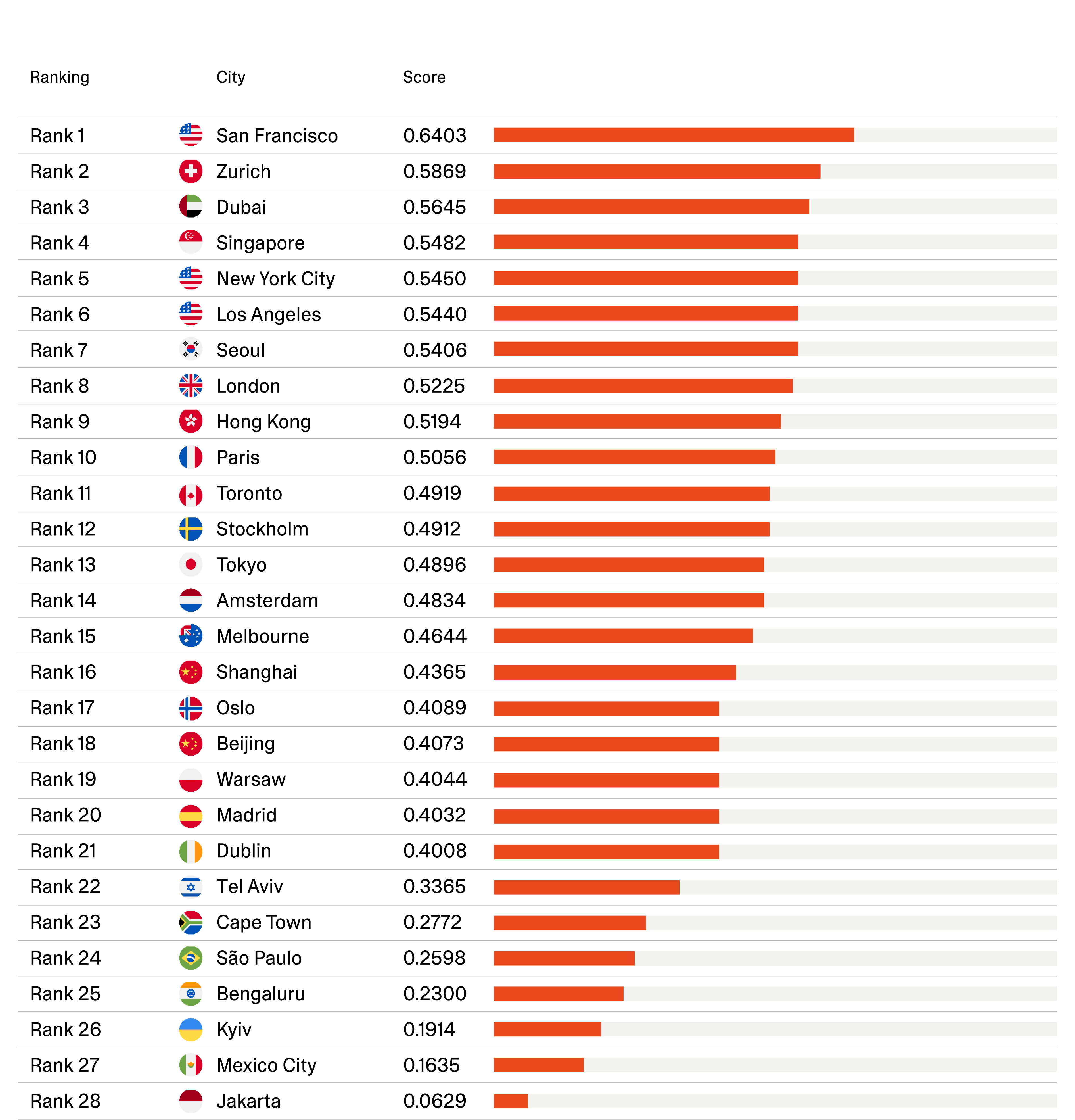
An index measuring and comparing the relative attractiveness of global cities for entrepreneurial activity, innovation, talent development, and business agility.
Key findings
#1 San Francisco
Remains the global benchmark, as it continues to combine unparalleled venture capital depth, density of start-ups, and a mature innovation ecosystem supported by strong digital and talent infrastructure.
#2 Zurich
Highlights Europe’s innovation strength, driven by exceptional educational quality, high living standards, and strong digital readiness, which offsets its smaller scale of venture activity.
#3 Dubai
A model of regulatory efficiency and digital ambition. Dubai’s rapid rise reflects an economy built for founders - fast to incorporate, frictionless to operate, and globally connected.
#4 Singapore
Singapore’s clarity in regulation, taxation, and digital infrastructure sets the standard for business agility. It remains the benchmark for founder mobility and cross-border scalability in Asia.
#5 New York
New York City combines deep venture activity with one of the world’s strongest financial infrastructures. However, its relatively lower quality-of-life scores moderate its ranking.
Observations
U.S. Start-Up Capitals Still Rule Venture Markets - But Struggle to Stay Livable
San Francisco (#1), New York (#5), and Los Angeles (#6) continue to lead due to their deep venture capital markets and dense start-up networks. However, their overall performance is moderated by low quality-of-life scores, driven by high living costs. These weaknesses underline that rising affordability pressures could erode their capacity to retain skilled talent and sustain ecosystem growth over time.
Bengaluru’s Entrepreneurial Gravity Is Too Strong to Ignore
Bengaluru hosts twice as many unicorns as Singapore (32 vs. 15), but ranks lower on the Startup Friendly Cities Index (#25 vs. #4). The drag comes from slower company registration processes and a relatively lower quality-of-life score. Yet, the city’s entrepreneurial energy is undeniable. If Bengaluru could streamline business setup, reduce tax friction, and invest in stronger digital infrastructure, it could break into the global top 10 startup-friendly cities. A similar pattern emerges in Beijing and Shanghai, which boast vast start up bases but lag behind Zurich and Dubai - cities that offer lower taxes, simpler regulations, and greater business agility. The takeaway is clear: venture activity alone doesn’t make an ecosystem globally competitive; it must be matched by enabling policy, infrastructure, and livability.
Europe Wins Through Steady Hands, Not Flashy Valuations
Zurich (#2), Paris (#10), and Amsterdam (#14) outperform many cities by maintaining steady performance across key dimensions. Zurich’s strong educational base and solid digital infrastructure compensate for its smaller venture scale, while Amsterdam combines high living standards with unrivalled access to high-calibre young talent. Both cities show that smaller European hubs can attract start-up activity through stability, livability, and institutional reliability rather than the sheer scale of investment or deal flow that defines the larger ecosystems. Paris maintains strong talent pipelines and institutional stability but faces higher corporate tax exposure and slower registration times, reducing their agility compared to smaller ecosystems.
London Defies the Exodus to Remain a Global Start-Up Epicentre
Despite ongoing wealth and talent outflows, London (#8) remains a resilient start-up hub. Its deep capital markets, global financial networks, and multicultural talent base continue to attract founders seeking credibility & scale. Even amid higher taxes and regulatory friction, London’s combination of access to investors, international visibility, government grants, and institutional trust keeps it anchored in the global top ten, a testament to its enduring entrepreneurial gravity.
Dubai and Singapore Rewrite the Start-Up Playbook for Agility
Dubai (#3) and Singapore (#4) demonstrate how efficiency and clarity in business operations can rival traditional innovation hubs. Dubai ranks among the top cities globally for business agility, driven by fast-paced registration procedures, low corporate taxes, and exceptional broadband speeds (412 Mbps). Singapore’s balanced profile, ranking in the top five for digital connectivity and top three for talent and livability, reinforces its reputation as one of the most structured and dependable start-up environments. Together, these cities illustrate how predictable governance and regulatory simplicity directly translate into entrepreneurial competitiveness.
Asia’s Rising Order: From Tokyo’s Stability to Seoul’s State-Backed Momentum
Tokyo (#13) remains a benchmark of consistency - balancing mature infrastructure with deep talent pools, though weighed down by higher taxes. Seoul (#7) and Hong Kong (#9) blend state-backed innovation with strong academic ecosystems, signaling a power shift toward a multipolar innovation map increasingly defined by Asian cities.
Emerging Markets Gain Momentum, but Bureaucracy Still Caps Their Potential
São Paulo (#24) and Cape Town (#23), and Mexico City (#27) represent the growing dynamism of emerging-market ecosystems but also the persistence of institutional bottlenecks. São Paulo, for example, records strong digital connectivity (0.66) and a large start-up base but is held back by long registration timelines (60 days) and high taxes. Cape Town and Mexico City perform moderately across livability and agility, but still face uneven governance and infrastructure quality. These cities demonstrate increasing entrepreneurial momentum but remain limited by policy inefficiencies that restrict scalability and global reach.
Conclusion
Where Founders Go, the Future Follows
Cities are no longer competing on geography. They are competing on experience. The ones that make it easiest to start, live, and scale will become the gravitational centers of global innovation.
Cities are, at their core, the infrastructure of ambition. The ones that attract and retain founders share a defining trait: frictionless access to capital, digital networks, talent, and a quality of life that sustains creativity. Multipolitan’s Startup Friendly Cities Index 2026 shows that the winners of the next decade will not be those with the deepest venture pockets but those that create the most enabling environments. From San Francisco’s ecosystem depth to Zurich’s precision, Dubai’s speed, and Singapore’s structure, the world’s most competitive cities make entrepreneurship predictable, scalable, and human. The equation is simple: founders follow efficiency, investors follow founders, and the cities that make it easiest to build will define the next chapter of global innovation.
Index Rankings
Startup Friendly Cities Index 2026
An index measuring and comparing the relative attractiveness of global cities for entrepreneurial activity, innovation, talent development, and business agility.
Key findings
#1 San Francisco
Remains the global benchmark, as it continues to combine unparalleled venture capital depth, density of start-ups, and a mature innovation ecosystem supported by strong digital and talent infrastructure.
#2 Zurich
Highlights Europe’s innovation strength, driven by exceptional educational quality, high living standards, and strong digital readiness, which offsets its smaller scale of venture activity.
#3 Dubai
A model of regulatory efficiency and digital ambition. Dubai’s rapid rise reflects an economy built for founders - fast to incorporate, frictionless to operate, and globally connected.
#4 Singapore
Singapore’s clarity in regulation, taxation, and digital infrastructure sets the standard for business agility. It remains the benchmark for founder mobility and cross-border scalability in Asia.
#5 New York
New York City combines deep venture activity with one of the world’s strongest financial infrastructures. However, its relatively lower quality-of-life scores moderate its ranking.
Observations
U.S. Start-Up Capitals Still Rule Venture Markets - But Struggle to Stay Livable
San Francisco (#1), New York (#5), and Los Angeles (#6) continue to lead due to their deep venture capital markets and dense start-up networks. However, their overall performance is moderated by low quality-of-life scores, driven by high living costs. These weaknesses underline that rising affordability pressures could erode their capacity to retain skilled talent and sustain ecosystem growth over time.
Bengaluru’s Entrepreneurial Gravity Is Too Strong to Ignore
Bengaluru hosts twice as many unicorns as Singapore (32 vs. 15), but ranks lower on the Startup Friendly Cities Index (#25 vs. #4). The drag comes from slower company registration processes and a relatively lower quality-of-life score. Yet, the city’s entrepreneurial energy is undeniable. If Bengaluru could streamline business setup, reduce tax friction, and invest in stronger digital infrastructure, it could break into the global top 10 startup-friendly cities. A similar pattern emerges in Beijing and Shanghai, which boast vast start up bases but lag behind Zurich and Dubai - cities that offer lower taxes, simpler regulations, and greater business agility. The takeaway is clear: venture activity alone doesn’t make an ecosystem globally competitive; it must be matched by enabling policy, infrastructure, and livability.
Europe Wins Through Steady Hands, Not Flashy Valuations
Zurich (#2), Paris (#10), and Amsterdam (#14) outperform many cities by maintaining steady performance across key dimensions. Zurich’s strong educational base and solid digital infrastructure compensate for its smaller venture scale, while Amsterdam combines high living standards with unrivalled access to high-calibre young talent. Both cities show that smaller European hubs can attract start-up activity through stability, livability, and institutional reliability rather than the sheer scale of investment or deal flow that defines the larger ecosystems. Paris maintains strong talent pipelines and institutional stability but faces higher corporate tax exposure and slower registration times, reducing their agility compared to smaller ecosystems.
London Defies the Exodus to Remain a Global Start-Up Epicentre
Despite ongoing wealth and talent outflows, London (#8) remains a resilient start-up hub. Its deep capital markets, global financial networks, and multicultural talent base continue to attract founders seeking credibility & scale. Even amid higher taxes and regulatory friction, London’s combination of access to investors, international visibility, government grants, and institutional trust keeps it anchored in the global top ten, a testament to its enduring entrepreneurial gravity.
Dubai and Singapore Rewrite the Start-Up Playbook for Agility
Dubai (#3) and Singapore (#4) demonstrate how efficiency and clarity in business operations can rival traditional innovation hubs. Dubai ranks among the top cities globally for business agility, driven by fast-paced registration procedures, low corporate taxes, and exceptional broadband speeds (412 Mbps). Singapore’s balanced profile, ranking in the top five for digital connectivity and top three for talent and livability, reinforces its reputation as one of the most structured and dependable start-up environments. Together, these cities illustrate how predictable governance and regulatory simplicity directly translate into entrepreneurial competitiveness.
Asia’s Rising Order: From Tokyo’s Stability to Seoul’s State-Backed Momentum
Tokyo (#13) remains a benchmark of consistency - balancing mature infrastructure with deep talent pools, though weighed down by higher taxes. Seoul (#7) and Hong Kong (#9) blend state-backed innovation with strong academic ecosystems, signaling a power shift toward a multipolar innovation map increasingly defined by Asian cities.
Emerging Markets Gain Momentum, but Bureaucracy Still Caps Their Potential
São Paulo (#24) and Cape Town (#23), and Mexico City (#27) represent the growing dynamism of emerging-market ecosystems but also the persistence of institutional bottlenecks. São Paulo, for example, records strong digital connectivity (0.66) and a large start-up base but is held back by long registration timelines (60 days) and high taxes. Cape Town and Mexico City perform moderately across livability and agility, but still face uneven governance and infrastructure quality. These cities demonstrate increasing entrepreneurial momentum but remain limited by policy inefficiencies that restrict scalability and global reach.
Conclusion
Where Founders Go, the Future Follows
Cities are no longer competing on geography. They are competing on experience. The ones that make it easiest to start, live, and scale will become the gravitational centers of global innovation.
Cities are, at their core, the infrastructure of ambition. The ones that attract and retain founders share a defining trait: frictionless access to capital, digital networks, talent, and a quality of life that sustains creativity. Multipolitan’s Startup Friendly Cities Index 2026 shows that the winners of the next decade will not be those with the deepest venture pockets but those that create the most enabling environments. From San Francisco’s ecosystem depth to Zurich’s precision, Dubai’s speed, and Singapore’s structure, the world’s most competitive cities make entrepreneurship predictable, scalable, and human. The equation is simple: founders follow efficiency, investors follow founders, and the cities that make it easiest to build will define the next chapter of global innovation.
Index Rankings
Startup Friendly Cities Index 2026
An index measuring and comparing the relative attractiveness of global cities for entrepreneurial activity, innovation, talent development, and business agility.
Key findings
#1 San Francisco
Remains the global benchmark, as it continues to combine unparalleled venture capital depth, density of start-ups, and a mature innovation ecosystem supported by strong digital and talent infrastructure.
#2 Zurich
Highlights Europe’s innovation strength, driven by exceptional educational quality, high living standards, and strong digital readiness, which offsets its smaller scale of venture activity.
#3 Dubai
A model of regulatory efficiency and digital ambition. Dubai’s rapid rise reflects an economy built for founders - fast to incorporate, frictionless to operate, and globally connected.
#4 Singapore
Singapore’s clarity in regulation, taxation, and digital infrastructure sets the standard for business agility. It remains the benchmark for founder mobility and cross-border scalability in Asia.
#5 New York
New York City combines deep venture activity with one of the world’s strongest financial infrastructures. However, its relatively lower quality-of-life scores moderate its ranking.
Observations
U.S. Start-Up Capitals Still Rule Venture Markets - But Struggle to Stay Livable
San Francisco (#1), New York (#5), and Los Angeles (#6) continue to lead due to their deep venture capital markets and dense start-up networks. However, their overall performance is moderated by low quality-of-life scores, driven by high living costs. These weaknesses underline that rising affordability pressures could erode their capacity to retain skilled talent and sustain ecosystem growth over time.
Bengaluru’s Entrepreneurial Gravity Is Too Strong to Ignore
Bengaluru hosts twice as many unicorns as Singapore (32 vs. 15), but ranks lower on the Startup Friendly Cities Index (#25 vs. #4). The drag comes from slower company registration processes and a relatively lower quality-of-life score. Yet, the city’s entrepreneurial energy is undeniable. If Bengaluru could streamline business setup, reduce tax friction, and invest in stronger digital infrastructure, it could break into the global top 10 startup-friendly cities. A similar pattern emerges in Beijing and Shanghai, which boast vast start up bases but lag behind Zurich and Dubai - cities that offer lower taxes, simpler regulations, and greater business agility. The takeaway is clear: venture activity alone doesn’t make an ecosystem globally competitive; it must be matched by enabling policy, infrastructure, and livability.
Europe Wins Through Steady Hands, Not Flashy Valuations
Zurich (#2), Paris (#10), and Amsterdam (#14) outperform many cities by maintaining steady performance across key dimensions. Zurich’s strong educational base and solid digital infrastructure compensate for its smaller venture scale, while Amsterdam combines high living standards with unrivalled access to high-calibre young talent. Both cities show that smaller European hubs can attract start-up activity through stability, livability, and institutional reliability rather than the sheer scale of investment or deal flow that defines the larger ecosystems. Paris maintains strong talent pipelines and institutional stability but faces higher corporate tax exposure and slower registration times, reducing their agility compared to smaller ecosystems.
London Defies the Exodus to Remain a Global Start-Up Epicentre
Despite ongoing wealth and talent outflows, London (#8) remains a resilient start-up hub. Its deep capital markets, global financial networks, and multicultural talent base continue to attract founders seeking credibility & scale. Even amid higher taxes and regulatory friction, London’s combination of access to investors, international visibility, government grants, and institutional trust keeps it anchored in the global top ten, a testament to its enduring entrepreneurial gravity.
Dubai and Singapore Rewrite the Start-Up Playbook for Agility
Dubai (#3) and Singapore (#4) demonstrate how efficiency and clarity in business operations can rival traditional innovation hubs. Dubai ranks among the top cities globally for business agility, driven by fast-paced registration procedures, low corporate taxes, and exceptional broadband speeds (412 Mbps). Singapore’s balanced profile, ranking in the top five for digital connectivity and top three for talent and livability, reinforces its reputation as one of the most structured and dependable start-up environments. Together, these cities illustrate how predictable governance and regulatory simplicity directly translate into entrepreneurial competitiveness.
Asia’s Rising Order: From Tokyo’s Stability to Seoul’s State-Backed Momentum
Tokyo (#13) remains a benchmark of consistency - balancing mature infrastructure with deep talent pools, though weighed down by higher taxes. Seoul (#7) and Hong Kong (#9) blend state-backed innovation with strong academic ecosystems, signaling a power shift toward a multipolar innovation map increasingly defined by Asian cities.
Emerging Markets Gain Momentum, but Bureaucracy Still Caps Their Potential
São Paulo (#24) and Cape Town (#23), and Mexico City (#27) represent the growing dynamism of emerging-market ecosystems but also the persistence of institutional bottlenecks. São Paulo, for example, records strong digital connectivity (0.66) and a large start-up base but is held back by long registration timelines (60 days) and high taxes. Cape Town and Mexico City perform moderately across livability and agility, but still face uneven governance and infrastructure quality. These cities demonstrate increasing entrepreneurial momentum but remain limited by policy inefficiencies that restrict scalability and global reach.
Conclusion
Where Founders Go, the Future Follows
Cities are no longer competing on geography. They are competing on experience. The ones that make it easiest to start, live, and scale will become the gravitational centers of global innovation.
Cities are, at their core, the infrastructure of ambition. The ones that attract and retain founders share a defining trait: frictionless access to capital, digital networks, talent, and a quality of life that sustains creativity. Multipolitan’s Startup Friendly Cities Index 2026 shows that the winners of the next decade will not be those with the deepest venture pockets but those that create the most enabling environments. From San Francisco’s ecosystem depth to Zurich’s precision, Dubai’s speed, and Singapore’s structure, the world’s most competitive cities make entrepreneurship predictable, scalable, and human. The equation is simple: founders follow efficiency, investors follow founders, and the cities that make it easiest to build will define the next chapter of global innovation.
Contributors

.png)
.png)
.png)

Articles